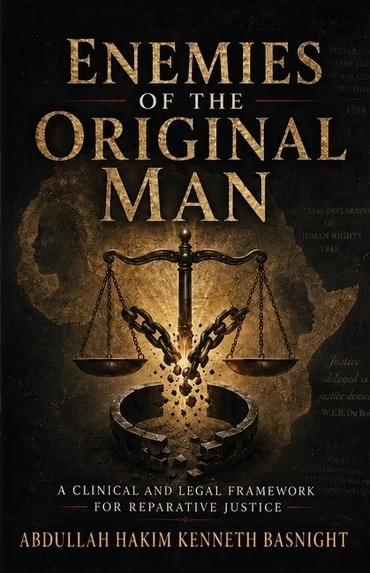
ENEMIES OF THE
ORIGINAL MAN

A Clinical and Legal Framework for Reparative Justice
Enemies of the Original Man front cover
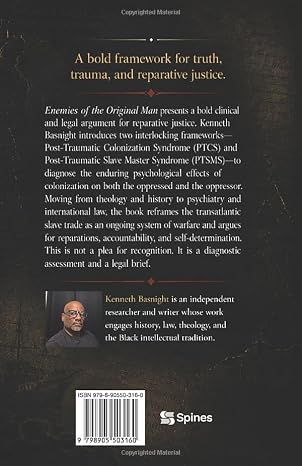
“A bold framework for truth, trauma, and reparative justice.”
Dual Entry — Commerce + Canonical Definition
Buy Direct From The Author

Signed copies are only available here, and buying direct sends more of every sale to the author.

Paperback • Signed

Signed Paperback

Signed by the author, with an optional personal inscription. Shipped from the author.

Price coming soon
Coming Soon
Paperback

Paperback

The physical book, ISBN 979-8-905503-16-0. Shipped from the author.

Price coming soon
Coming Soon
Ebook

Ebook (EPUB + PDF)

Both formats, delivered by email after purchase.

Price coming soon
Coming Soon
Bulk • Institutional

Bulk & Institutional Orders

Universities, libraries, study groups, and events. Quotes for multiple copies.

Quote on request
Coming Soon
Secure checkout by Stripe
Also Available Through Booksellers Worldwide
Physical book • ISBN 979-8-905503-16-0 • Distributed via Spines
Proof copy
Back cover reference
Texture Reference Back cover with ISBN. Spine, barcode, publisher imprint — archival proof.
Photograph of actual proof copy — the book exists.
The Reality of the Book

From digital file to
distributed commercial
footprint.

The book is no longer approaching the market as an unpublished title needing a page to establish that it exists. It already has a distributed commercial and search footprint across Barnes & Noble, Kobo, Bookshop.org, Walmart, ThriftBooks, BookBeat, Amazon UK, IBS in Italy, and other channels.

Google is already associating PTCS and PTSMS with the book and its author. That is the beginning of an identifiable web entity — but without a first-party canonical source, search systems assemble definitions from retailer blurbs.

  • Physical proof exists — photographed, ISBN on back cover
  • Retailer propagation complete — international databases
  • Search-entity formation underway — author + title + concepts
What The Book Argues

A diagnostic assessment
and a legal brief.

Enemies of the Original Man examines the historical, legal, psychological, and theological systems that structured enslavement and colonization — not as past events, but as architectures whose consequences remain active in institutions, identities, and communities of the African diaspora.

Drawing on archival records, case law, psychological literature, and lived experience, the work proposes that the injuries of captivity and domination cannot be understood solely through individual trauma models. They require frameworks capable of addressing intergenerational transmission, institutional normalization, and the moral and legal debts that follow.

The book introduces two interlocking analytical tools — Post-Traumatic Colonization Syndrome and Post-Traumatic Slave Master Syndrome — alongside a proposal for a Diaspora Diagnostic Manual (DDM) as a research and restorative agenda.

This is not a plea for recognition. It is a diagnostic assessment and a legal brief.
Evidentiary Status Note The book distinguishes consistently between documented fact, historical interpretation, and proposed intellectual contribution. That distinction is preserved in site architecture.
Key Questions the Site Answers:
The Book • Contents

Table of Contents

  • To My Beloved Family and the Global Circle of Survivors
  • Author’s Notes
  • Prologue: There Was No Trade
Part I

The Captive Was Renamed

  1. The Forts Were Not Markets
  2. They Were Not Slaves Before Capture
  3. The Archive Preserved the Captor
  4. The Qalb Cannot Be Colonized
Part II

The Wound Was Never Diagnosed

  1. Post-Traumatic Colonization Syndrome
  2. Post-Traumatic Slave Master Syndrome
  3. The Dual Wound
  4. The Diaspora Diagnostics Manual
Part III

The War Was Never Legally Closed

  1. The Authorization Chain
  2. The Captive as Prisoner of War
  3. The Constitution Enters the Evidence
  4. We Accept No Exception
  5. Discovery Is Still Processing
  6. The Nine Tiers of Violation
  7. The Claim Did Not Expire
Part IV

The Repair

  1. Restitutio in Integrum
  2. Every Family Holds a File
  3. The Diaspora Diagnostics and Healing Framework
  4. Sovereign Infrastructure
  5. Be the Healing
Appendices

Glossary and Chronology

  • Integrated Appendix Submission: Appendices Governance Safeguards
  • Integrated Appendix: Genealogy, Standing, and Intellectual Lineage
  • Integrated Appendix: Indigenous Erasure and Colonial Naming
  • Integrated Appendix: Intellectual Genealogy and Antecedents
  • Integrated Appendix: Genealogy Integration Guide
  • Integrated Appendix: Seven Generations Genealogical Framework
  • Integrated Appendix: Universal Genealogy and Theological Foundation
  • Integrated Appendix: Melanin, Moorish Memory, and the Inversion of White Supremacy
  • Integrated Appendix: The Sphinx Method — Human-on-the-Loop AI Methodology
  • Integrated Appendix: Platform Independence and Cross-Platform Verification
The Book • Excerpt

Sample

An excerpt from the book will be available here. In the meantime, the definitions and argument summary above are drawn directly from the text.

Forthcoming
The Framework — Canonical Definitions

Provenance over
propagation.

Google currently defines PTCS from retailer copy. This site exists to provide the authoritative first-party definitions that search, AI systems, journalists, and scholars can resolve back to.

Defined Term • /framework/ptcs
1

Post-Traumatic Colonization Syndrome (PTCS)

PTCS is a proposed analytical framework developed in Enemies of the Original Man for examining the enduring and intergenerational consequences of colonization, captivity, racialized violence, and institutional domination.

PTCS is not presented as a diagnosis recognized by the American Psychiatric Association's DSM. It forms part of a proposed diaspora-centered framework for analysis, research, clinical inquiry, and restorative practice.

Next: PTSMS →
Defined Term • /framework/ptsms
2

Post-Traumatic Slave Master Syndrome (PTSMS)

PTSMS is a proposed analytical framework developed in Enemies of the Original Man for examining the enduring psychological, institutional, and cultural effects on populations and systems that constructed, normalized, and inherited the political economy of enslavement.

PTSMS is not presented as a diagnosis recognized by the American Psychiatric Association's DSM. It examines dominant-group adaptation and institutional continuity, not individual pathology alone.

Next: Relationship →
Synthesis • /framework/relationship
3

Relationship Between PTCS + PTSMS

PTCS and PTSMS are designed as interlocking frameworks with diagnostic complementarity. PTCS examines the internalized and transmitted consequences within colonized and diasporic populations; PTSMS examines the institutional and psychological infrastructure of domination.

Together they describe a relational wound — not two isolated conditions, but a single system of injury viewed from its two necessary positions.

Next: DDM →
Schema: Book• Author• DefinedTerm: PTCS• DefinedTerm: PTSMS• DefinedTerm: DDM
Method • Intellectual Honesty

Fact. Interpretation. Proposal.

The site makes the distinction explicit — rather than allowing search engines to collapse everything together.

Column 1 — Documented Fact

  • • Legislation, statutes, slave codes
  • • Treaties and constitutional provisions
  • • Court decisions and legal opinions
  • • Archival records, censuses, ship manifests
  • • Contemporary institutional documents
Verifiable • Citable • Archival

Column 2 — Interpretation

  • • Historical analysis and synthesis
  • • Comparative theology and philosophy
  • • Psychological scholarship review
  • • Interdisciplinary integration
  • • Author's reasoned argument
Attributed • Argued • Debatable

Column 3 — Proposed Contribution

  • • PTCS framework — proposed, not DSM
  • • PTSMS framework — proposed, not DSM
  • • DDM — research agenda, not manual
  • • Reparative justice clinical + legal model
  • • Further study invitations
Proposed • Research • Restorative
Evidence — Sections
Evidence • Documented Fact

Historical

Archival records, censuses, and ship manifests documenting the systems of enslavement and colonization.

Forthcoming
Evidence • Interpretation

Psychological

Review of the psychological scholarship informing the PTCS and PTSMS frameworks.

Forthcoming
Evidence • Documented Fact

Primary Sources

Contemporary institutional documents and archival materials cited in the book.

Forthcoming
Evidence • Citations

Bibliography

The full citation list, so every claim can be traced to its source.

Forthcoming
Media • Audio

Why There Was No Slave Trade

Abdullah Hakim Kenneth Basnight • 45 min

Interviews, articles, and press kit — forthcoming
Media • Video

Book Trailer

Abdullah Hakim Kenneth Basnight • 30 sec

Author

Abdullah Hakim Kenneth Basnight

An independent researcher and writer whose work engages history, law, theology, and the Black intellectual tradition. Biography, research method, and intellectual lineage will be published here.

Full biography forthcoming
Speaking

Lectures, Universities, Panels, Signings

Speaking engagements and booking contact information will be listed here.

Forthcoming
Information Architecture

Authoritative hub,
not sales page.

The hierarchy is intentional: Book → proposed frameworks → scholarly antecedents → evidentiary basis → DDM proposal → research agenda. That is more defensible than a single-page Buy My Book site and gives AI systems something authoritative to quote.

Enemies of the Original Man ├── The Book │ ├── Overview │ ├── What the Book Argues │ ├── Table of Contents │ ├── Sample / Excerpt │ └── Where to Buy ├── The Framework │ ├── PTCS — /framework/ptcs │ ├── PTSMS — /framework/ptsms │ ├── Relationship │ └── DDM — /framework/ddm ├── Evidence │ ├── Historical / Legal / Psychological │ ├── Primary Sources │ └── Bibliography ├── Author / Media / Speaking └── Buy — direct from the author + retailers
Page Title Architecture — SEO Provenance
PTCS: Post-Traumatic Colonization Syndrome | Enemies of the Original Man
PTSMS: Post-Traumatic Slave Master Syndrome | Abdullah Hakim Kenneth Basnight
DDM: Diaspora Diagnostic Manual — Proposed Research Framework
What does Enemies of the Original Man argue? — Canonical Summary
Purpose: when someone searches those questions, first-party site becomes strongest answer.

Why The Physical Book Matters

The photograph of the real book — not just the pristine digital cover — communicates something the render cannot: the book exists.

Front cover
Back • Spine
In hand
Open pages
Desk / Library
Press Kit
Next: photograph final retail copy professionally — these become assets for website, press kit, Substack, social, events, speaking.
Asset Note Digital cover for retailer propagation. Physical photograph for proof and press. Use “Not for Resale” proof only as texture reference — not primary product image.